Silent Era-
The first animated projection (screening) was created in France, by Charles-Émile Reynaud, who was a French science teacher. Reynaud created the Praxinoscope in 1877 and the Théâtre Optique in December 1888. On 28 October 1892, he projected the first animation in public,Pauvre Pierrot, at the Musée Grévin in Paris. This film is also notable as the first known instance of film perforations being used. His films were not photographed, but drawn directly onto the transparent strip. In 1900, more than 500,000 people had attended these screenings.
The first (photographed) animated projection was "Humorous Phases of Funny Faces" (1906) by newspaper cartoonist J. Stuart Blackton, one of the co-founders of the Vitagraph Company arrived. In the movie, a cartoonist's line drawings of two faces were 'animated' (or came to life) on a blackboard. The two faces smiled and winked, and the cigar-smoking man blew smoke in the lady's face; also, a circus clown led a small dog to jump through a hoop.
The first animated projection in the traditional sense (i.e., on motion picture film) was "Fantasmagorie" by the French director Émile Cohl in 1908. This was followed by two more films, "Le Cauchemar du fantoche" ["The Puppet's Nightmare", now lost] and "Un Drame chez les fantoches" ["A Puppet Drama", called "The Love Affair in Toyland" for American release and "Mystical Love-Making" for British release], all completed in 1908.
One of the very first successful animated cartoons was Gertie the Dinosaur (1914) by Winsor McCay. It is considered the first example of true character animation. At first, animated cartoons were black-and-white and silent. Felix the Cat and Oswald the Lucky Rabbit are notable examples.
Golden Age-
From the 1930s to 1960s, theatrical cartoons were produced in huge numbers, and usually shown before a feature film in a movie theater. MGM, Disney, Paramount and Warner Brothers were the largest studios producing these 5 to 10-minute "shorts".
The first cartoon to use a soundtrack was in 1926 with Max Fleischer's My Old Kentucky Home. However the Fleischers used a De Forestsound system and the sound was not completely synchronized with the film. Walt Disney's 1928 cartoon Steamboat Willie starring Mickey Mouse was the first to use a click track during the recording session, which produced better synchronism. "Mickey Mousing" became a term for any movie action (animated or live action) that was perfectly synchronized with music. The music used is original most of the time, butmusical quotation is often employed. Animated characters usually performed the action in "loops", i.e., drawings were repeated over and over.
Although other producers had made films earlier using 2 strip color, Disney produced the first cartoon in 3 strip Technicolor, "Flowers and Trees", in 1932. Technicians at the Fleischer studio invented rotoscoping, in which animators trace live-action in order to make animation look more realistic. However, rotoscoping made the animation look stiff and the technique was later used more for studying human and animal movement, rather than directly tracing and copying filmed movements.
Later, other movie technologies were adapted for use in animation, such as multiplane cameras with The Old Mill (1937), stereophonic soundin Fantasia (1940), widescreen processes with Lady and the Tramp (1955), and even 3D.
Today, traditional animation uses traditional methods, but is aided by computers in certain areas.
Television -
Competition from television drew audiences away from movie theaters in the late 1950s, and the theatrical cartoon began its decline. Today, animated cartoons are produced mostly for television.
American television animation of the 1950s featured quite limited animation styles, highlighted by the work of Jay Ward on Crusader Rabbit.Chuck Jones coined the term "illustrated radio" to refer to the shoddy style of most television cartoons that depended more on their soundtracks than visuals. Other notable 1950s programs include UPA's Gerald McBoing Boing, Hanna-Barbera's Huckleberry Hound and Quick Draw McGraw, and rebroadcast of many classic theatrical cartoons from Warner Brothers, MGM, and Disney.
The Hanna-Barbera cartoon, The Flintstones, was the first successful primetime animated series in the United States, running from 1960-66 (and in reruns since). While many networks followed the show's success by scheduling other cartoons in the early 1960s, including Scooby-Doo, Where Are You!,The Jetsons, Top Cat, and The Alvin Show, none of these programs survived more than a year (save Scooby-Doo, which, despite not being a primetime cartoon, has managed to stay afloat for over four decades). However, networks found success by running these shows as Saturday morning cartoons, reaching smaller audiences with more demographic unity among children. Television animation for children flourished on Saturday morning, on cable channels like Nickelodeon, Disney Channel and Cartoon Network, and in syndicated afternoon timeslots.
Commercial animation-
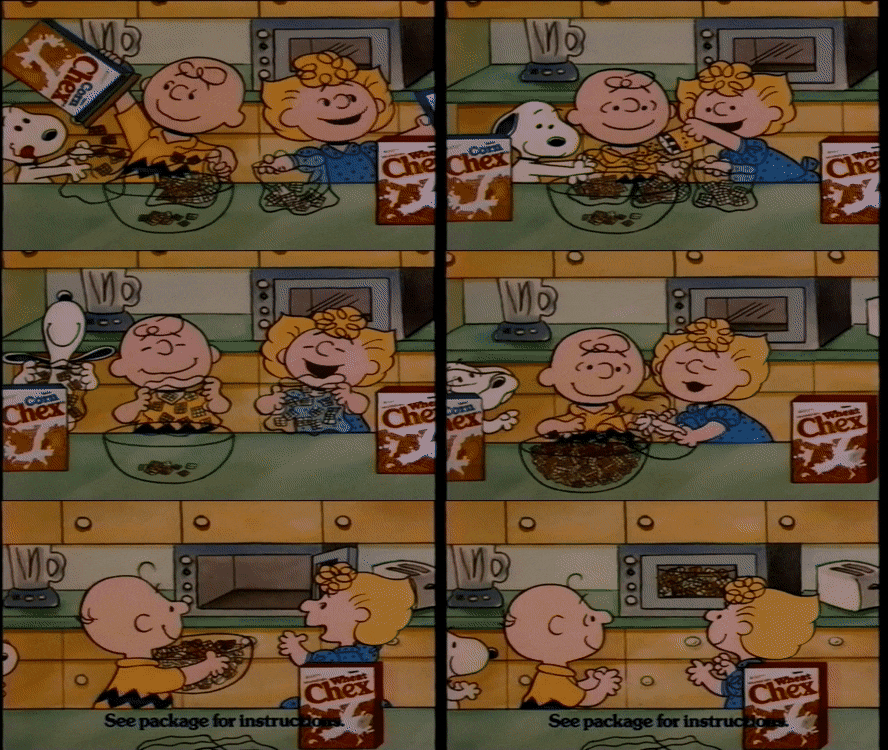
Animation has been very popular in television commercials, both due to its graphic appeal, and the humor it can provide. Some animated characters in commercials have survived for decades, such as Snap, Crackle and Pop in advertisements for Kellogg's cereals.
The legendary animation director Tex Avery was the producer of the first Raid "Kills Bugs Dead" commercials in 1966, which were very successful for the company.
History Of Animation –
Early examples of attempts to capture the phenomenon of motion drawing can be found in paleolithic cave paintings, where animals are depicted with multiple legs in superimposed positions, clearly attempting to convey the perception of motion.
A 5,000 year old earthen bowl found in Iran in Shahr-i Sokhta has five images of a goat painted along the sides. This has been claimed to be an example of early animation. However, since no equipment existed to show the images in motion, such a series of images cannot be called animation in a true sense of the word.
A Chinese zoetrope-type device had been invented in 180 AD. Thephenakistoscope, praxinoscope, and the common flip book were early popular animation devices invented during the 19th century.
These devices produced the appearance of movement from sequential drawings using technological means, but animation did not really develop much further until the advent of cinematography.
There is no single person who can be considered the "creator" of film animation, as there were several people working on projects which could be considered animation at about the same time.
Georges Méliès was a creator of special-effect films; he was generally one of the first people to use animation with his technique. He discovered a technique by accident which was to stop the camera rolling to change something in the scene, and then continue rolling the film. This idea was later known as stop-motion animation. Méliès discovered this technique accidentally when his camera broke down while shooting a bus driving by. When he had fixed the camera, a hearse happened to be passing by just as Méliès restarted rolling the film, his end result was that he had managed to make a bus transform into a hearse. This was just one of the great contributors to animation in the early years.
The earliest surviving stop-motion advertising film was an English short by Arthur Melbourne-Cooper called Matches: An Appeal (1899). Developed for the Bryant and May Matchsticks company, it involved stop-motion animation of wired-together matches writing a patriotic call to action on a blackboard.
J. Stuart Blackton was possibly the first American film-maker to use the techniques of stop-motion and hand-drawn animation. Introduced to film-making by Edison, he pioneered these concepts at the turn of the 20th century, with his first copyrighted work dated 1900. Several of his films, among them The Enchanted Drawing (1900) and Humorous Phases of Funny Faces (1906) were film versions of Blackton's "lightning artist" routine, and utilized modified versions of Méliès' early stop-motion techniques to make a series of blackboard drawings appear to move and reshape themselves. 'Humorous Phases of Funny Faces' is regularly cited as the first true animated film, and Blackton is considered the first true animator.
Another French artist, Émile Cohl, began drawing cartoon strips and created a film in 1908 called Fantasmagorie. The film largely consisted of a stick figure moving about and encountering all manner of morphing objects, such as a wine bottle that transforms into a flower. There were also sections of live action where the animator’s hands would enter the scene. The film was created by drawing each frame on paper and then shooting each frame onto negative film, which gave the picture a blackboard look. This makes Fantasmagorie the first animated film created using what came to be known as traditional (hand-drawn) animation.
Following the successes of Blackton and Cohl, many other artists began experimenting with animation. One such artist was Winsor McCay, a successful newspaper cartoonist, who created detailed animations that required a team of artists and painstaking attention for detail. Each frame was drawn on paper; which invariably required backgrounds and characters to be redrawn and animated. Among McCay's most noted films are Little Nemo (1911), Gertie the Dinosaur (1914) andThe Sinking of the Lusitania (1918).
The production of animated short films, typically referred to as "cartoons", became an industry of its own during the 1910s, and cartoon shorts were produced to be shown in movie theaters. The most successful early animation producer was John Randolph Bray, who, along with animator Earl Hurd, patented the cel animation process which dominated the animation industry for the rest of the decade.
Traditional Animation-
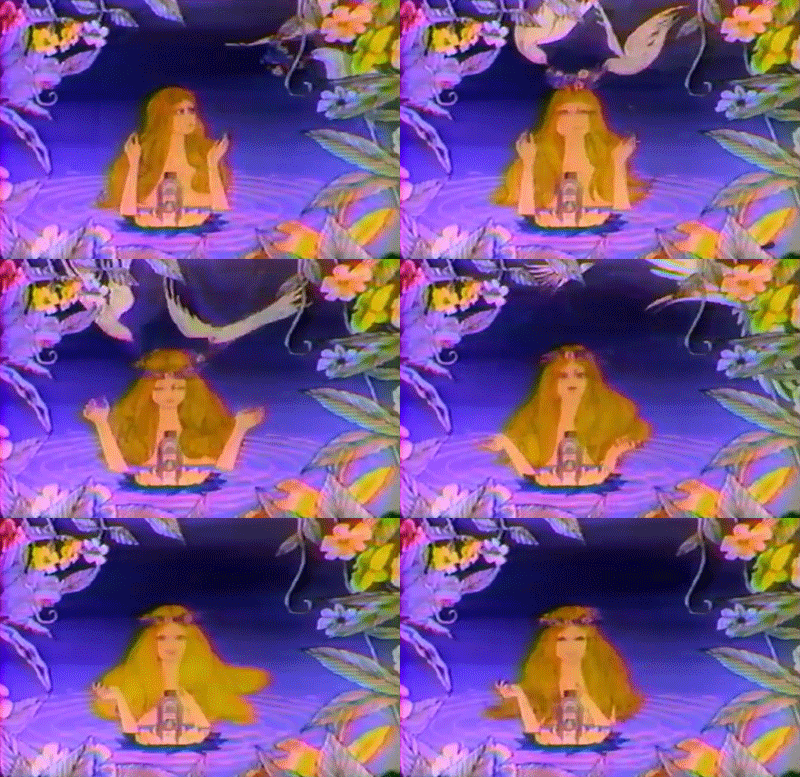
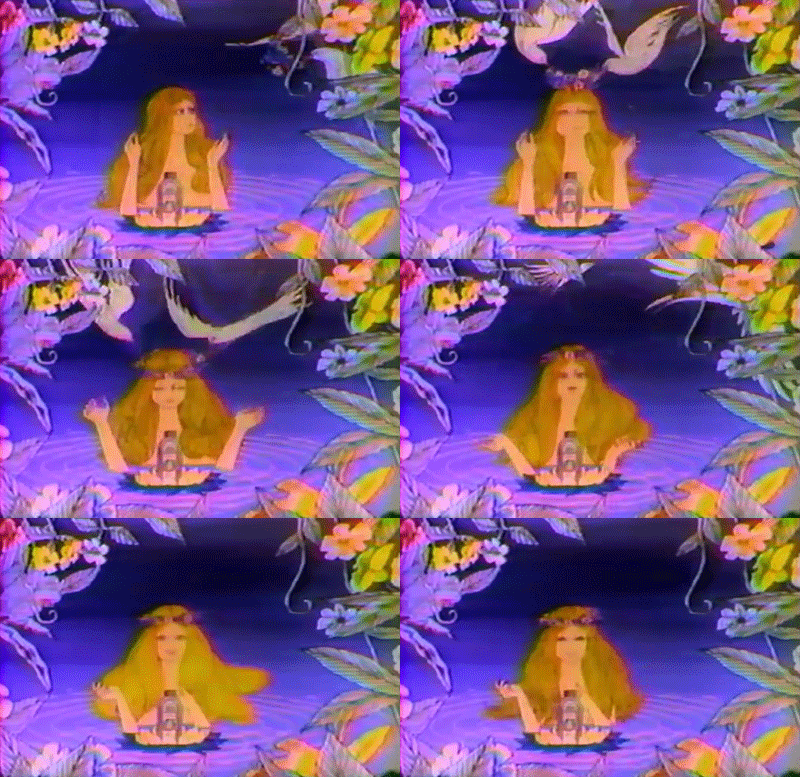
Traditional animation (also called cel animation or hand-drawn animation) was the process used for most animated films of the 20th century. The individual frames of a traditionally animated film are photographs of drawings, which are first drawn on paper. To create the illusion of movement, each drawing differs slightly from the one before it. The animators' drawings are traced or photocopied onto transparent acetate sheets called cels, which are filled in with paints in assigned colors or tones on the side opposite the line drawings. The completed character cels are photographed one-by-one onto motion picture film against a painted background by a rostrum camera.
The traditional cel animation process became obsolete by the beginning of the 21st century. Today, animators' drawings and the backgrounds are either scanned into or drawn directly into a computer system. Various software programs are used to color the drawings and simulate camera movement and effects. The final animated piece is output to one of several delivery media, including traditional 35 mm film and newer media such as digital video. The "look" of traditional cel animation is still preserved, and the character animators' work has remained essentially the same over the past 70 years. Some animation producers have used the term "tradigital" to describe cel animation which makes extensive use of computer technology.
Full animation refers to the process of producing high-quality traditionally animated films, which regularly use detailed drawings and plausible movement. Fully animated films can be done in a variety of styles, from more realistically animated works such as those produced by the Walt Disney studio (Beauty and the Beast, Aladdin, Lion King) to the more 'cartoony' styles of those produced by theWarner Bros. animation studio. Many of the Disney animated features are examples of full animation, as are non-Disney works such as The Secret of NIMH (US, 1982), The Iron Giant (US, 1999), and Nocturna (Spain, 2007).
Limited animation involves the use of less detailed and/or more stylized drawings and methods of movement. Pioneered by the artists at the American studio United Productions of America, limited animation can be used as a method of stylized artistic expression, as inGerald McBoing Boing (US, 1951), Yellow Submarine (UK, 1968), and much of the anime produced in Japan. Its primary use, however, has been in producing cost-effective animated content for media such as television (the work of Hanna-Barbera, Filmation, and other TV animation studios) and later the Internet (web cartoons).
Rotoscoping is a technique, patented by Max Fleischer in 1917, where animators trace live-action movement, frame by frame. The source film can be directly copied from actors' outlines into animated drawings, as in The Lord of the Rings (US, 1978), or used in a stylized and expressive manner, as in Waking Life (US, 2001) and A Scanner Darkly (US, 2006). Some other examples are: Fire and Ice(USA, 1983) and Heavy Metal (1981).
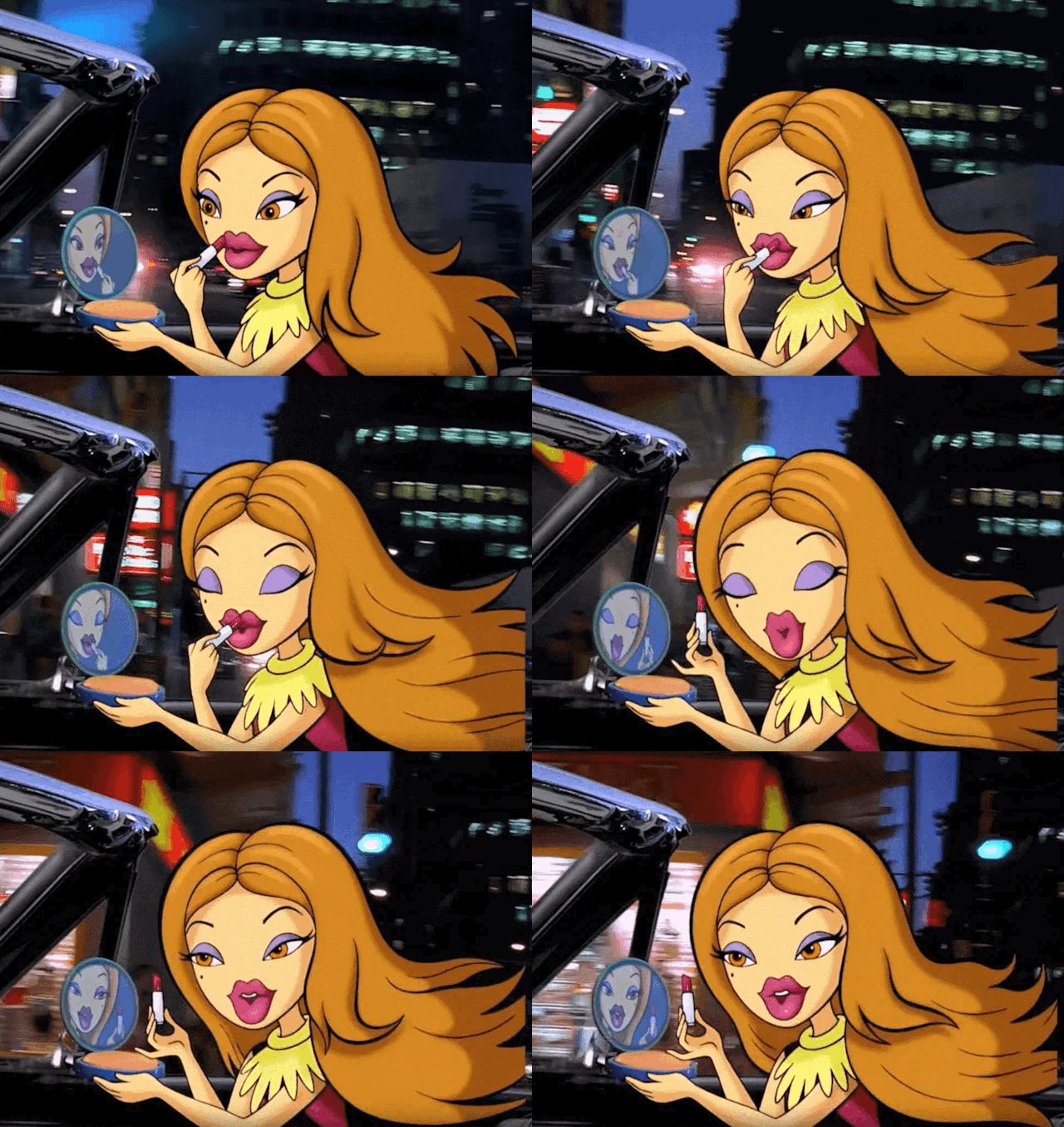
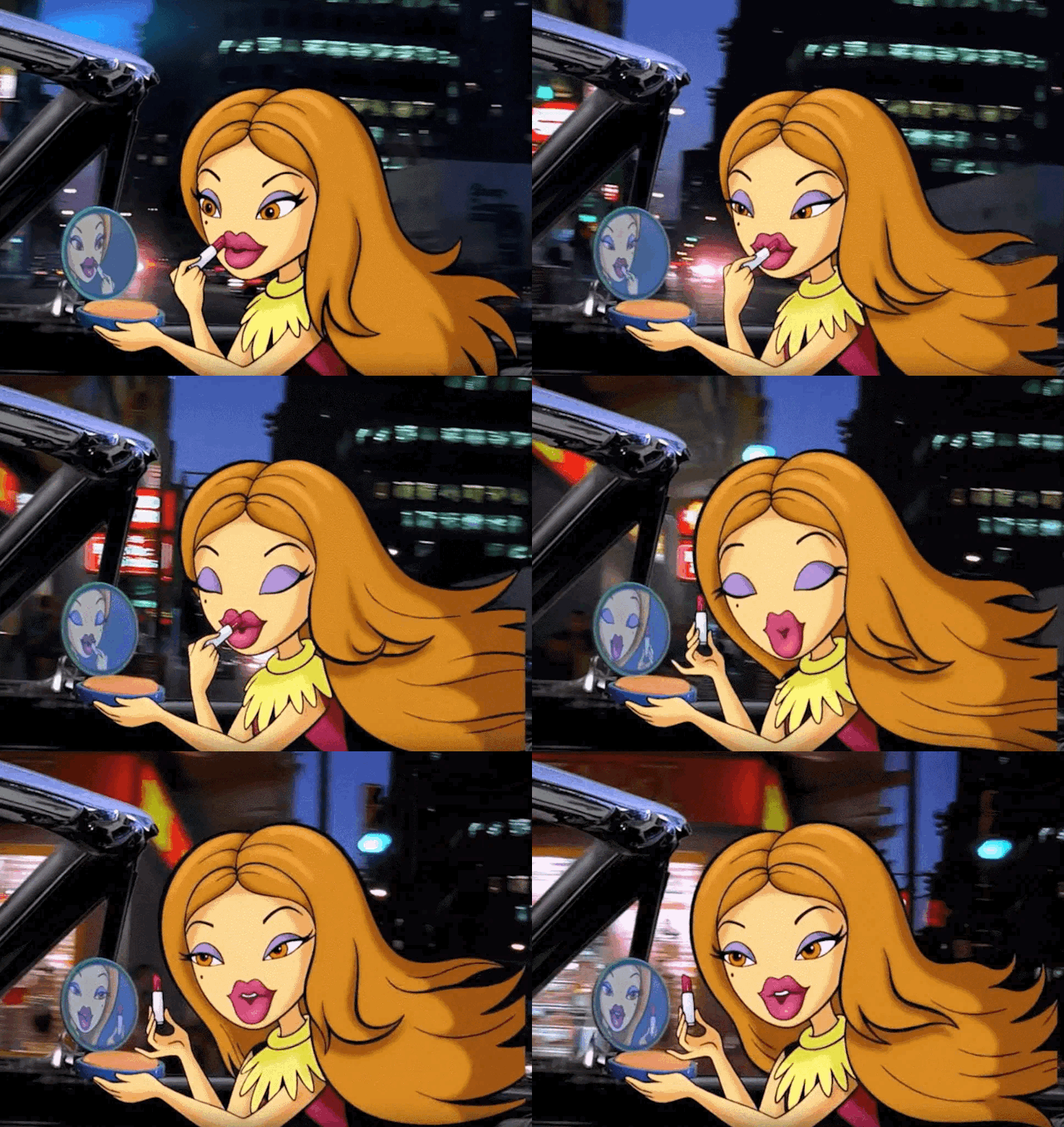
Live-action/animation is a technique, when combining hand-drawn characters into live action shots. One of the earlier uses of it was Koko the Clown when Koko was drawn over live action footage. Other examples would include Who Framed Roger Rabbit (USA, 1988),Space Jam (USA, 1996) and Osmosis Jones (USA, 2002).
Computer Animation-
Computer animation encompasses a variety of techniques, the unifying factor being that the animation is created digitally on a computer. This animation takes less time than previous traditional animation. Computer animation is the process used for generating animated images by using computer graphics. The more general term computer generated imageryen compasses both static scenes and dynamic images, while computer animationonly refers to moving images.
Modern computer animation usually uses 3D computer graphics, although2D computer graphics are still used for stylistic, low bandwidth, and faster real-time renderings. Sometimes the target of the animation is the computer itself, but sometimes the target is another medium, such as film.
Computer animation is essentially a digital successor to the stop motion techniques used in traditional animation with 3D models and frame-by-frame animation of 2D illustrations. Computer generated animations are more controllable than other more physically based processes, such as constructing miniatures for effects shots or hiring extras for crowd scenes, and because it allows the creation of images that would not be feasible using any other technology. It can also allow a single graphic artist to produce such content without the use of actors, expensive set pieces, or props.
To create the illusion of movement, an image is displayed on the computer screen and repeatedly replaced by a new image that is similar to it, but advanced slightly in the time domain (usually at a rate of 24 or 30 frames/second). This technique is identical to how the illusion of movement is achieved with television and motion pictures.
For 3D animations, objects (models) are built on the computer monitor (modeled) and 3D figures are rigged with a virtual skeleton. For 2D figure animations, separate objects (illustrations) and separate transparent layers are used, with or without a virtual skeleton. Then the limbs, eyes, mouth, clothes, etc. of the figure are moved by the animator on key frames. The differences in appearance between key frames are automatically calculated by the computer in a process known as tweening or morphing. Finally, the animation is rendered.
For 3D animations, all frames must be rendered after modeling is complete. For 2D vector animations, the rendering process is the key frame illustration process, while tweened frames are rendered as needed. For pre-recorded presentations, the rendered frames are transferred to a different format or medium such as film or digital video. The frames may also be rendered in real time as they are presented to the end-user audience. Low bandwidth animations transmitted via the internet (e.g. 2D Flash, X3D) often use software on the end-users computer to render in real time as an alternative to streaming or pre-loaded high bandwidth animations.

2D & 3Danimation-
2D animation figures are created and/or edited on the computer using 2D bitmap graphics or created and edited using 2D vector graphics. This includes automated computerized versions of traditional animation techniques such as of, interpolated morphing, onion skinning and interpolated rotoscoping.
2D animation has many applications, including analog computer animation, Flash animation and PowerPoint animation. Cinemagraphs are still photographs in the form of an animated GIF file of which part is animated.
3D animation is digitally modeled and manipulated by an animator. In order to manipulate a mesh, it is given a digital skeletal structure that can be used to control the mesh. This process is called rigging. Various other techniques can be applied, such as mathematical functions (ex. gravity, particle simulations), simulated fur or hair, effects such as fire and water and the use of motion capture to name but a few, these techniques fall under the category of 3D dynamics. Well-made 3D animations can be difficult to distinguish from live action and are commonly used as visual effects for recent movies. Toy Story (1995, USA) is the first feature-length film to be created and rendered entirely using 3D graphics.